Monday, May 19, 2014

I love Paris in the spring time. . .

By now you must be wondering if we ever leave our neighborhood. We do—and here's the proof:


Along the Seine.


Louvre courtyard.
Louvre exterior.
Yes, Venus de Milo.
Uncategorized artifact found on chair in Louvre.

Photo shoot outside of Louvre--note the "love locks" on bridge. Lovers put their
initials on a lock, secure it to the bridge, and then throw the key in the river.
 It's become a huge problem. The authorities use bolt cutters to periodically remove the locks.
Kevin in the Tuileries garden.

The pigeon man.
At an art exhibition at the Grand Palais.


Get your fruit, cheese, fish—and socks—at the Rue Ordener market.

Twice a week, on Wednesday and Saturday, our street comes alive with activity. Vendors stands line the street for blocks.  You can get almost anything at the Rue Ordener market, and it’s all artfully displayed.


Thursday, May 15, 2014

The story of Square Léon Serpollet is told in laughter and tears.

Léon Serpollet is our neighborhood park.  It’s not a grand park. It’s simply a place where old men can sit and talk, grandmas can watch their grandchildren on the play equipment, and teenagers can shoot hoops or just hang out.  It’s a place where little kids chase pigeons, and dogs chase balls and wriggle their tails.


The park is named for Lèon Serpollet, who broke the world land-speed record in his steam car in 1902 (75 miles per hour), a record previously held by an electric car.  But it’s not the park’s namesake that I will remember when I look back in the years ahead.  It’s a sign that I will recall, and in particular, one line.

The sign recounts that during the Nazi occupation, the Vichy government passed laws forbidding “dogs and Jews” from using public places, including parks and gardens like Park Lèon Serpollet. In the 18th arrondissement, where we are staying, over 700 children were sent to the Nazi extermination camps. Then comes the line that is especially poignant, the line that says 90 of the children were babies less than 14 days old “who never had the joy of playing in a garden.”


This sign, like all the others across Europe, reminds us:  Never forget.

Have pass, will travel?

We have our Navigo Decouverte monthly passes that put all of Paris within our reach.  It covers the metro (subway), the bus, and even the little funicular that takes you up the steps from near Abbesses to Sacre Coeur.  

An added bonus of the monthly pass is that, on weekends, we can travel outside of Paris on the RER (suburban train line) free! We can go to Versailles, Fountainbleu, and other sites without having to spend a cent to get there.

I must confess we had a problem with the pass at first. After we bought it, we were denied entry at three different metro stations, but the passes always worked on the bus.  We could not figure out why they were so inconsistent. Finally we discovered that in some metro stations, you have to push on the turnstile, rather than just wait for the doors to open, as they do if you have a single ticket.  Chalk it up to "operator error."

I didn't think the authorities would accept our scans of our driver's licenses for our photos—but they did! 


See what's just around the corner (or up the hill).

Here's a look at some places that are within a 10 to 20 minute walk from our apartment. (Or about as far as from our condo in Kenmore to the cement plant and Lake Forest Park, as Kevin points out. Hmm. Not quite the same.)  You may recognize some of the sites from films.


Although you can't really see the sign in the photo, the pink building with the yellow-topped fence, made famous by Picasso when he paintedit in 1905, became known as Le Lapin Agile after Andre Gill painted the sign for the proprietor that showed a rabbit leaping out of a saucepan. Thanks to locals calling the place "Le Lapin à Gill" (Gill's Rabbit), it eventually became Le Lapin Agile (The Agile Rabbit.)

The vineyard pictured is the first vineyard planted in Montmartre. It's still in operation today.


We had a pique-nique in the shadow of Sacre Coeur.  (If you ever visit, go all the way around to the back and down a side street to a charming little park. The basilica may be crowded, but you'll find peace there.)


La Moulin de la Galette. Toulouse-Laturec, Van Gogh, and Renoir all painted scenes of this site.

Many artists and writers lived at Le Bateau-Lavoir. Most of the building burned down in 1970, but the facade was saved, and it has been rebuilt. 

Abbesses metro station is one of only two of the original glass-covered metro entrances 
left in Paris.


The Love Wall in Montmartre has "I love you," written in 250 languages.


Montmartre also features a sculpture called "The Man Who Could Walk Through Walls," based on a charming story of  a man who discovered he could easily pass through walls without trouble. Originally, he sought a doctor's help, and the doctor gave him some pills for the conditon. But the man did not take them, and a year went by. He turned to a life of crime, using his talent to burgle and rob. But then, he fell in love with a married woman.  He passed un-noticed through her bedroom wall. One night he had a headache and found some pills he had with him. He took them, and his headache disappeared, but as he was leaving his lover, he suddenly became trapped in the wall. The pills, of course, were the ones  he had been given by his doctor the year before.

In my neighborhood at home, there are posters of lost dogs and cats. In Montmartre, there is a poster for a lost unicorn. The poster says she is a large female unicorn, white with a large horn, last seen at the Concorde entrance of the Garden of the Tuileries.  I will have to look for her there! There is a reward.


Tuesday, May 13, 2014

Is there a reason the word voyeur is French?


Do you remember the Hitchcock film “Rear Window”?  How the character played by Jimmy Stewart became obsessed with watching his neighbors while recuperating from an injury? I only ask because I worry that our Paris apartment is turning me into a voyeur.

Our living and dining areas look out onto an inner courtyard where many of the neighbors leave their blinds up long into the night.  Our apartment is only slightly better, with long string curtains—like beaded curtains, but lacking the beads—that provide only a modicum of privacy. So while we can see the neighbors, I’m sure they can see us too. I need to remember that.

Fortunately, unlike Jimmy Stewart, I don’t—yet—suspect any of them of murder. But while I was looking out the window on Saturday night, I saw several scenes play out, all within about five minutes.

Scene 1
The neighbor directly across from us leaned out of his window to smoke a cigarette. He disappeared back into the apartment.

His wife (?) and small son (?) sat down near the window to play a hand-slapping game. I couldn’t really see the mom—but the boy, who must have been about five, had dark hair in a style not unlike an early Beatles cut, and he was jumping about with abandon.

Then, an enormous black-and-white fluffy cat sauntered, in the way only cats can do, onto their small balcony to chew on some vegetation growing in a pot.

Meanwhile on the first floor, just above and to the right of the door was scene 2.

Scene 2
Another young man, probably in his thirties, leaned out of his window, also smoking a cigarette. (I hope they have smoke detectors in this building.)

While he was smoking, another young man and a woman greeted him.  He called down and waved them to come up. (It later became apparent he was having a party as more guests arrived. Though they didn’t wake me, I got up briefly at 1:30 a.m. and saw their lights were on and that people were still talking animatedly behind the window.)

Earlier in the evening, I saw another slice of life a floor lower and to the right of the couple with the child, which comprised scene 3.

Scene 3
At that window, a pretty Japanese woman (or Japanese French woman) with long dark hair was chopping (vegetables?) in her kitchen. As she chopped away, a man, whom I could only dimly see, moved behind her and embraced her.  She stopped chopping, turned around, pulled him close, and they kissed. I felt a little guilty having witnessed that private moment, but it made me happy.

Moments like that could make anyone a voyeur. (I hope I keep seeing her. I don’t need that kind of Rear Window moment.)  But I wonder if they sell binoculars at the Marchés aux Puces, the world’s largest flea market, which is held not far away every Saturday.  (I'm only kidding about that!)

Note: I originally posted a view from our window, but I deleted it, because I didn't want to worry our neighbors.


Sunday, May 11, 2014

Welcome to our apartment on Rue Ordener.


For those of you who want to know what our place in Paris is like, here’s a description:

Our apartment is in a 19th Century Haussmann building on Rue Ordener in Montmartre. The Haussmann buildings are those typically associated with Paris, with their narrow wrought-iron balconies holding little more than a few flower-pots. (Under Napoleon III, Haussmann razed great sections of the city  to construct its grand boulevards and elegant buildings, giving Paris much of the look it has today.) 


Partly the reconstruction was done for sanitation, since the medieval buildings were crowded and rife with disease, and partly it was done to control dissent—it was easy for protesters to barricade the narrow, winding passages of old Paris—which was not true of Haussmann’s grand, wide boulevards.)

We love the herringbone-style oak on our apartment’s floor and its high ceilings and detailed moldings.  By contrast, the decoration is quite modern, with many playful elements, like the bright pink floor lamp! While that’s not a style I would have chosen, it adds a touch of fun, and I think the owners did a good job of blending the formal old building with today’s look.

The living room or lounge. 
For Paris, the apartment is fairly spacious at over 700 square feet.  It has three bedrooms—one with a king bed that converts into two twins, one with a queen, and another tiny child’s bedroom with a single bed. 
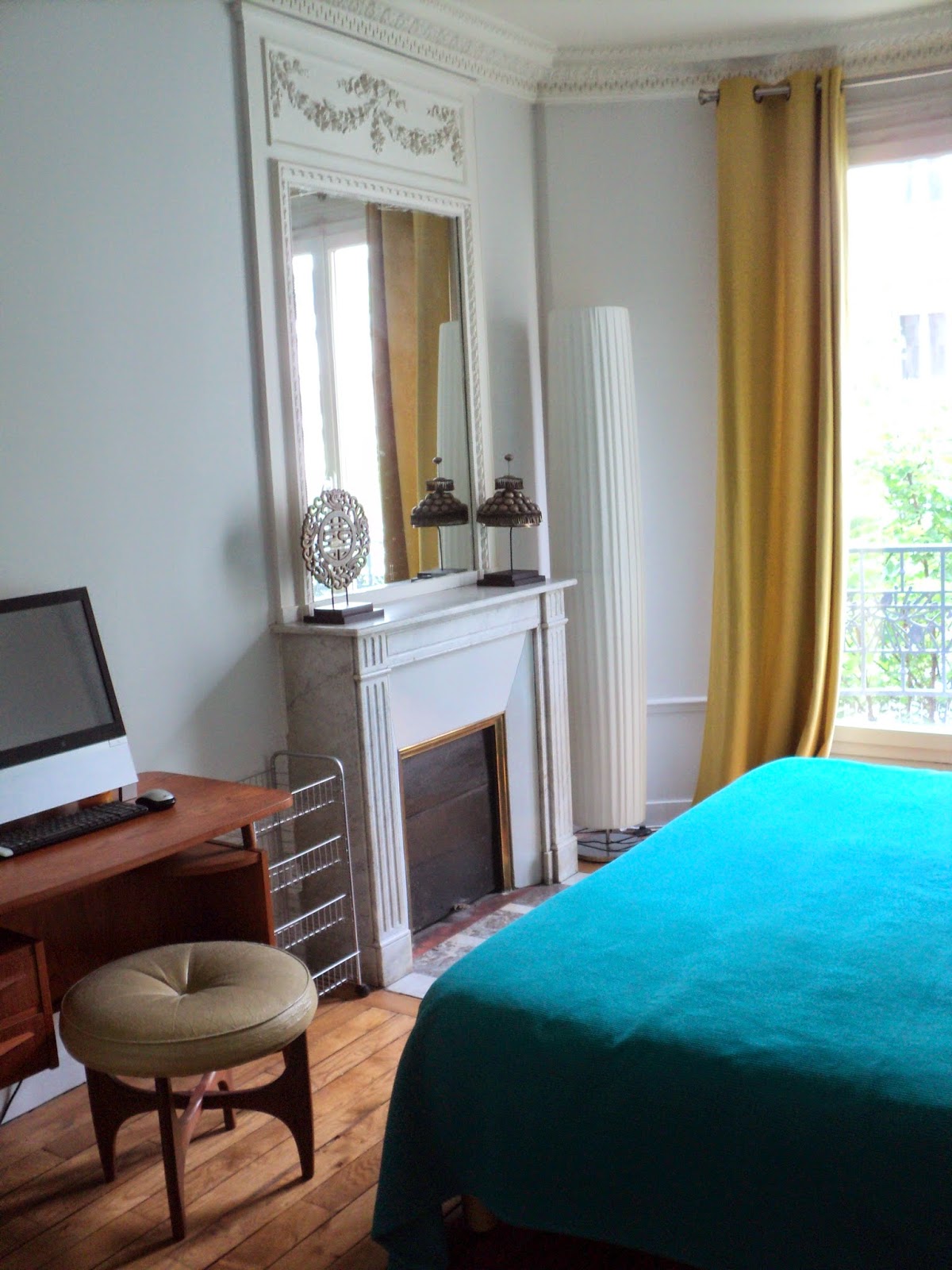
The bedroom with the large bed.

It has a large vestibule for an entry, which adds to the open feeling, a bathroom with shower and bath, a separate toilet room—common in Europe—and all the “mod cons” as some British friends would say. It’s equipped with a flat-screen TV, a washing machine (in the bathroom), a fairly large refrigerator, a microwave, an espresso maker (yes!), a dishwasher, a phone, a computer, a wireless printer, and wifi (pronounced wee-fee in French). 


The second bedroom with the queen bed.


We have four fireplaces (none working): one in each bedroom, one in the living room, and one in the kitchen. The wireless printer sits in the kitchen fireplace!


The high ceilings and ornate moldings add to the charm of this quintessentially
French home.


We also appreciate the neighborhood, with everything from
the grocery store to street markets to a boulangerie (for our daily fresh baguette) close at hand, three metro stations within an 8-to-10 minute walk, and three buslines nearby. (More on the neighborhood later in a separate post.)


The elegant ceiling molding.

One of the most delightful features of the building is its elevator—an ancient wrought-iron masterpiece barely big enough for two people and two carry-on suitcases, as we soon discovered. The inside is lined with beautiful French oak.  I feel like I’m living in a movie every time I use it!


Interestingly, this elevator is much faster than the one or at our condo in Kenmore. We travel the four floors here faster than to the second floor at Inglewood Shores. (Here we live on the troisième étage, or the third floor in France, because what Americans call the “first floor” is termed the “ground floor” in Europe, and the ”second floor,” in US terms, is the ”first floor” here.)

I’m thankful this apartment is everything—and more—that the owner described in her listing on VRBO.  

The sink, stove with oven, and dishwasher.


Although I did extensive online research before we rented the apartment, I couldn’t really relax until we settled in.  Now? We feel privileged to be here.  On only the second day, it’s almost starting to feel like home.

It should be a great base for our explorations and for relaxing with our family and friends.


The European-style kitchen has a hidden  refrigerator/freezer
(partially visible). which is fairly large (especially for France), as well as a  hidden microwave.